Personal financial education · Delivered with community partners
Community Financial Wellness
Practical financial education for stronger communities. Individuals build the knowledge, confidence, and practical habits needed for greater financial stability.
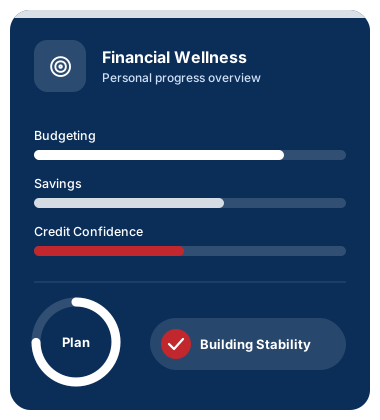
What is Community Financial Wellness?
Financial knowledge, confidence, and habits that support stability.
Community Financial Wellness is FSBO Academy’s distinct personal financial-education division. FSBO Academy partners with nonprofit organizations, workforce-development programs, employers, municipalities, and community institutions to help individuals build the knowledge, confidence, and practical habits needed for greater financial stability.
Track outcome
An individual with stronger financial knowledge, habits, confidence, planning skills, and financial stability.
Populations served
Adults reached through trusted community partners
Participants are individuals who take part through partner organizations. Specific populations are defined together with each partner.
Nonprofit organizations
Community members served by nonprofit organizations.
Workforce-development programs
Job seekers and workers participating in workforce programs.
Municipalities
Residents served through municipal and public-private community initiatives.
Schools and community colleges
Adult learners at schools and community colleges.
Employers
Employees participating through workplace financial-wellness programs.
Veteran-serving and community-based organizations
Individuals served by veteran-serving and other community-based organizations.
Youth programming is not offered through this track.
Featured program
FSBO Financial Literacy Cohort™
An instructor-led cohort that helps participants strengthen their personal financial knowledge and build a plan they can act on.
Curriculum topics
- Financial mindset and goal setting
- Budgeting and personal cash flow
- Savings and emergency planning
- Understanding consumer credit
- Debt management
- Banking fundamentals
- Financial confidence
- Personal financial action planning
Program components
- FSBO Financial Wellness Assessment
- Instructor-led educational modules
- Personal Financial Action Plan
- Participant workbook
- Practical financial exercises
- Individual support or coaching when included in the partnership
- Pre-program and post-program measurement
- Completion recognition
The four-part process
Step 1: Assess
Begin with the FSBO Financial Wellness Assessment to understand each participant’s starting point.
Step 2: Educate
Instructor-led modules cover the program topics.
Step 3: Apply
Practical financial exercises put learning into practice.
Step 4: Strengthen
Participants complete a Personal Financial Action Plan to sustain new habits.
Program tools
Assessment and action plan
FSBO Financial Wellness Assessment
A program assessment that helps establish where each participant is starting and supports pre-program and post-program measurement. It is not a credit check or a financial-advice product.
Personal Financial Action Plan
Each participant develops a personal plan built from their own goals, budget, and priorities, with practical next steps.
Participants are never asked on this site to provide Social Security numbers, bank-account details, credit reports, dates of birth, or other sensitive personal financial information.
Working together
Delivery, responsibilities, and support
Delivery options
- Community Financial Wellness cohorts
- Customized workshops
- Workforce-development integration
Community-partner responsibilities
- Identify the population to be served
- Help connect participants to the program
- Coordinate logistics with the Academy
- Support agreed outcome reporting
Participant expectations
- Take part in instructor-led modules
- Complete practical exercises
- Complete pre-program and post-program measurement
- Develop a Personal Financial Action Plan
Support and coaching options
Individual support or coaching is available when included in the partnership.
Primary partner audiences
Who partners with us on Community Financial Wellness
- Nonprofit organizations
- Workforce-development programs
- Municipalities
- Schools and community colleges
- Employers
- Veteran-serving organizations
- Community-based organizations
Programs may support applicable CRA, community-development, or financial-education objectives for financial-institution sponsors, depending on the institution, geography, participants, activity structure, documentation, and applicable regulatory requirements.
Track-specific outcome framework
How Community Financial Wellness is measured
These are placeholders. No figures are published until verified results are supplied.
Frequently asked questions
Community Financial Wellness FAQs
Individuals who take part through partner organizations such as nonprofits, workforce-development programs, employers, municipalities, schools, and veteran-serving or community-based organizations.
Financial mindset and goal setting, budgeting and personal cash flow, savings and emergency planning, understanding consumer credit, debt management, banking fundamentals, financial confidence, and personal financial action planning.
No. This website does not ask for Social Security numbers, bank-account information, credit reports, dates of birth, or other sensitive personal financial information.
Individual support or coaching is included when it is part of the partnership agreement.
Through pre-program and post-program measurement, completion tracking, and completed action plans. Results are reported only once verified and approved.
Submit a partnership inquiry and choose Community Financial Wellness as your preferred track. The Academy will follow up to discuss your population, objectives, and reporting needs.
Bring Financial Wellness to Your Organization
Start a partnership inquiry to discuss delivery options for the people your organization serves.